
If so, you need to be aware of these new rules.
Update from HMRC 3rd September 2026
What happens if you do not register?
Check if and when you need to register as a tax adviser with HMRC - GOV.UK
Updated guidance following the end of the first registration window on 18 August 2026. Added information for agents who missed their registration window or are new to the market, and what may happen if they do not register when required.
Update from HMRC 14th May 2026
A tool to check if you need to register as a tax adviser has been added to the ‘Who needs to register’ section.
https://www.gov.uk/guidance/check-if-and-when-you-need-to-register-as-a-tax-adviser-with-hmrc
Update from the Law Society 27th April 2026
Ask the experts: HMRC mandatory tax adviser registration
https://www.lawsociety.org.uk/topics/property/q-and-a/hmrc-mandatory-tax-adviser-registration
ILFM Blog: 30/03/26
If so, you need to be aware of these new rules.
- Conveyancing, with tax filings, such as SDLT returns;
- Probate or trusts, which entails corresponding with HMRC; or
- Corporate or commercial transactions, which require submissions to HMRC.
… you must comply, whether you deal with HMRC by phone, by email, by post, by online messages on the GOV.UK website or the HMRC app, or by submitting any return, claim, or document. If you don’t comply, the consequences could be expensive: they could include an immediate suspension from interacting with HMRC, financial penalties of at least £5,000, which can be levied on both the legal firm and the relevant individuals, or a requirement for sanctioned advisers to inform their clients.
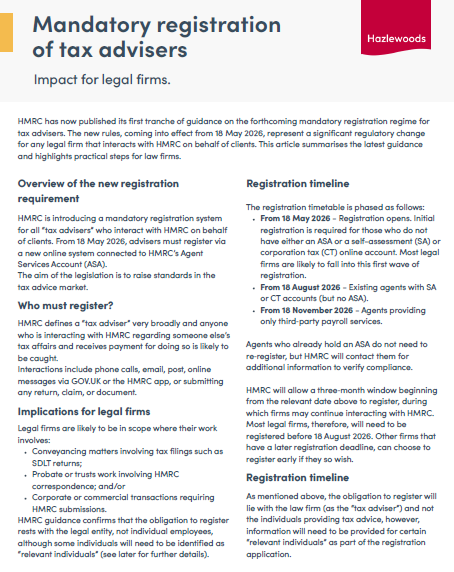
These new rules will come into effect on 18 May 2026. On that date, registration will open and you must register if you do not have an Agent Services Account (ASA) or an online account for self-assessment (SA) or corporation tax (CT). If you do already hold an ASA, you do not need to re‐register, but HMRC will contact you for additional information to verify your compliance. HMRC will allow firms until 18 August 2026 to register, in the meantime, you may continue to interact with HMRC. (Note * below)
To be able to register, the firm and each of the relevant individuals - see the next paragraph for who they are - must have no outstanding tax liabilities or returns, must not be subject to an anti- avoidance measure, must not be under HMRC sanctions or suspensions and must have no criminal convictions. The firm must also provide evidence that the individuals are supervised for anti-money laundering and that they are not disqualified from acting as a director in the UK or overseas.
HMRC defines a tax adviser very broadly and anyone who is interacting with HMRC about someone else’s tax affairs and receives payment for doing so is likely to be affected by this rule change. The obligation to register rests with the legal entity and not with individual employees. Some individuals will need to be identified as relevant individuals. These include:
- Officers of the business, including partners, directors and members of LLPs; and
- Employees who exercise control or significant influence over the firm’s tax related work or who perform activities that fall within the definition of a tax adviser’s functions.
Your checklist to prepare
- Assess whether your firm interacts with HMRC on behalf of its clients. Map out all practice areas where contact with HMRC contact could occur - think about conveyancing, probate, corporate, litigation etc.
- Confirm whether your firm already has an Agent Services Account (ASA): note that only one ASA can be set up per firm. If the firm does have an ASA already, ensure all contact details are up to date ahead of HMRC’s requests for verification.
- Identify all relevant individuals. Begin reviewing the roles of officers, the firm’s governance structures and the responsibilities of employees to determine all the relevant individuals.
- Review the conditions for registration. Confirm that the firm and individuals are not likely to have any barriers to meeting the conditions of registration.
- Establish the firm’s processes for keeping records. Anticipate a requirement to confirm these every year, so monitor the conditions of registration conditions, along with any changes in relevant individuals.
* If your firm does not have an ASA but is an existing agent with an SA or CT account, the deadline for registration is extended to 18 August 2026. If your firm provides only third‐party payroll services, the deadline for registration is extended to 18 November 2026.
Use the checklist now and prepare for registration under the new rules before 18 May 2026.
Here is helpful PDF Document produced by Hazlewoods > Click on link or below image for full document.
Comments